
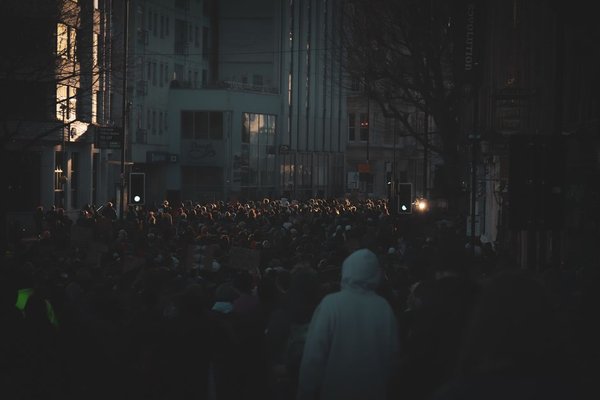
The right to peaceful protest in the UK protects more than the freedom to hold a placard. It allows people to gather, challenge public decisions and make disagreement visible. Yet attending a demonstration can raise practical questions: must you notify the police, can officers move a crowd, and does causing inconvenience make a protest unlawful? The answers depend on human rights principles, public-order legislation and where in the UK the protest takes place.
Where does the right to peaceful protest come from?
Two provisions of the European Convention on Human Rights are central. Article 10 protects freedom of expression, including political messages that others may find uncomfortable or offensive. Article 11 protects freedom of peaceful assembly and association. The Human Rights Act 1998 brings these protections into domestic law and generally requires public authorities, including the police, to act compatibly with them.
These rights protect participants as well as organisers. A demonstration does not lose protection simply because it attracts criticism or temporarily inconveniences others. Police also have a responsibility to facilitate peaceful assembly, not merely control it. However, peaceful assembly law does not give anyone an unlimited right to obstruct roads, intimidate people or commit offences.
When can the police restrict a demonstration?
Articles 10 and 11 are qualified rights. Restrictions need a legal basis, must pursue a recognised aim, such as preventing disorder or protecting other people’s rights, and must be necessary and proportionate. Proportionality means considering whether a less intrusive response could address the actual risk.
For example, concerns about access to a hospital might justify moving demonstrators away from an entrance rather than stopping a peaceful rally altogether. The fact that a protest is noisy, unpopular or inconvenient does not, by itself, automatically justify a ban. Police decisions must be assessed against the circumstances and the statutory powers being used.
Police protest powers in England and Wales
The Public Order Act 1986 is a major source of police powers to impose conditions on public processions and assemblies. Depending on the applicable legal test, officers may restrict a march’s route or timing, or specify where and how long an assembly can take place. Conditions may arise from risks of serious public disorder, serious property damage, serious disruption or legally defined intimidation.
The Police, Crime, Sentencing and Courts Act 2022 expanded aspects of these powers, including provisions concerning serious disruption and noise. The Public Order Act 2023 introduced specific offences connected with tactics such as locking on, tunnelling and interference with key infrastructure. These laws do not mean every disruptive protest is automatically criminal, but particular conduct may expose participants to arrest or prosecution.
A 2025 Court of Appeal ruling also matters: regulations attempting to lower the serious-disruption threshold to anything more than minor disruption were held unlawful and quashed. Readers should therefore be wary of older protest rights UK guides that still treat those regulations as operative law.
What changed under the Crime and Policing Act 2026?
Further changes came into force in 2026. In England and Wales, police must consider relevant cumulative disruption when assessing repeated protests in the same area. The law also allows conditions concerning protests near places of worship where the statutory test relating to intimidation and access is met. Senior commanders can exercise certain condition-setting powers without being physically present at the scene.
New rules also address concealing identity in specially designated protest areas. This is not a universal ban on wearing a face covering at demonstrations; the designation and the reason for covering the face matter, with protections concerning health, religion and work. These developments make it especially important to check current conditions rather than rely on advice written before 2026.
Do you need permission or advance notice?
In England and Wales, organisers of most planned public marches must give written notice to the police at least six clear days beforehand, providing details such as the route and organisers. If that is not reasonably practicable, notice should be given as soon as possible. A stationary protest ordinarily does not require the same advance notification. Notification is not the same as asking the police to approve your political message.
Rules differ across the UK. In Scotland, public processions are subject to a separate local-authority notification system. Northern Ireland has its own parades framework, with advance notification generally required at least 28 days before a public procession, subject to exceptions where earlier notice is impracticable. Always check the rules for the particular event and nation.
What should you do if police impose conditions?
Imagine a peaceful demonstration outside a town hall. Officers say the crowd must move because an emergency access route is becoming blocked. Rather than assume the entire protest has been banned, ask which legal power applies, what precise condition has been imposed and where demonstrators may continue. Organisers can communicate that information clearly to avoid confusion.
If you disagree with a direction, remaining calm and documenting what happened is usually safer than trying to resolve the legal dispute on the pavement. Breaching a valid condition that you knew or ought to have known about can be a criminal offence. Whether a condition was lawful can be challenged through legal processes; it should not be assumed invalid simply because the demonstration is peaceful.
Police may have separate stop-and-search or arrest powers where the relevant legal grounds exist. Being present at a protest alone is not a blanket justification for searching everyone. Ask officers to identify the power used and keep a record of their details if practical. If arrested, request legal advice. People wanting more background can explore guidance on stop and search rights and making complaints about police conduct.
Frequently asked questions
Is peaceful protest a legal right in the UK?
Yes. Articles 10 and 11, given domestic effect through the Human Rights Act, protect expression and peaceful assembly. Those protections are strong but qualified, so lawful, necessary and proportionate restrictions are possible.
Can police stop a protest because it disrupts traffic?
Traffic disruption can be relevant, but it does not automatically remove human rights protection. The police need an applicable statutory power and must consider necessity and proportionality. Specific obstruction offences may also apply to particular conduct.
Can I attend a protest without notifying the police?
Attendees generally do not have the organiser’s advance-notice duty. In England and Wales, stationary protests ordinarily need no march notification, while organisers of planned marches generally do. Different rules apply in Scotland and Northern Ireland.
Does a police condition mean a protest is banned?
Not necessarily. A condition often regulates where, when or how a demonstration happens. A full prohibition is a different and more exceptional step, subject to its own legal requirements. Ask for the exact terms rather than relying on rumours.
Protecting the right while understanding its limits
The right to peaceful protest in the UK remains a fundamental democratic safeguard, even as public-order rules evolve. The useful distinction is between a protected message and conduct that may lawfully be regulated. Knowing the local notification rules, checking any police conditions and understanding how proportionality works helps people exercise their rights confidently and responsibly.